The RFQ Is Hot.
Unfortunately, Your Estimator Is Not Available.
It is 2:47 on a Thursday when a promising RFQ hits your inbox.
The customer needs a large forged component; the quantities are good, and the drawing looks like the kind of work your shop does well. The buyer wants a quote quickly. There is just one problem. The person who knows how to price the job is currently standing in front of a machine trying to figure out why a production order is running behind schedule. The RFQ waits.
Friday morning brings three more quote requests, a tooling problem, an inspection question, and a customer asking whether another job can ship two days early. By the time anyone has a chance to give the original drawing a serious review, the weekend is here. You submit your quotation Monday afternoon. The response comes back: “Thanks. The order has already been placed with another vendor.”
Ouch.
For many machine shops, quoting has become one of the most important production bottlenecks in the business, even though no machines are involved.
The Modern Buyer Has Zero Patience
Purchasing departments are under the same pressures as machine shops.
They are being asked to reduce inventory, shorten procurement cycles, obtain competitive pricing, and keep production moving. When they send an RFQ, they may be contacting several suppliers simultaneously. Response time is make-or-break.
A shop can have killer equipment, experienced machinists, do great work, and have really competitive pricing and still lose a job because another supplier responded first. In a lot of cases, buyers are not choosing the lowest price. They are choosing a qualified supplier that can give them confidence quickly. That creates a real challenge for machine shops that rely on one or two people for estimating.

The Knowledge Bottleneck
Ask who prepares the most complex estimates in a typical machine shop and the answer is something like: “Joe handles those.” Joe might be the owner, plant manager, senior programmer, manufacturing engineer, or an estimator with 30 years of experience. That experience is valuable, but it is also really hard to scale.
A complicated forged component can’t always be dropped into estimating software and priced automatically. Someone has to interpret the drawing, think through the manufacturing sequence, calculate setup time, estimate tooling, and consider inspection requirements.
For a forged part, the estimator has to understand what is actually going to arrive at the shop.
How much material will need to be removed? What is the surface condition? How much stock exists around the finished dimensions? Will heavy scale need to be removed? Has the forging already been ultrasonically tested?
Every unknown adds time to the quoting process, and every unknown adds money to the quote.
Uncertainty Is Expensive
Estimators have a responsibility to protect the shop. If they do not know exactly how much cleanup a forging will need, they need to allow for the possibility that it will take way longer than expected. That may mean adding machining hours, extra setup time, and additional tooling. As a result, the quote may be safe, but it is not competitive.The alternative is quoting aggressively and praying everything goes according to plan.
That may win the job, but is gonna kill the margin.
Neither approach is great. The best answer is to reduce uncertainty before the estimate is prepared.
Better Starting Material Can Simplify the Quote
All Metals & Forge Group helps machine shops remove some of the variables when buying custom open-die forged parts.
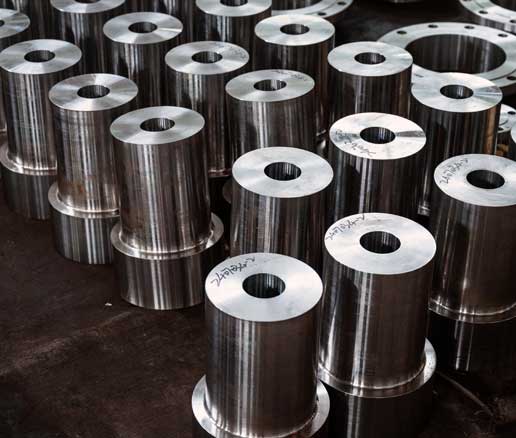
AMFG typically supplies every forging manufactured rough-machined to a surface condition of 250 RMS or better and to within 3 millimeters of the customer’s finished dimensions.
That gives the estimator a way better starting point. Instead of guessing how much time the shop will spend cutting through scale and removing excess stock from an as-forged surface, the estimator can work from a forging that is already much, much closer to its finished size.
For a machine shop, that predictability means:
- Better machining-time calculations
- More predictable tooling consumption
- Fewer contingency hours
- More confidence when pricing tight-margin work
- Fast evaluation of incoming RFQs
The objective here is not to eliminate the judgment of an experienced estimator. It is to give that estimator better information to start with.
Ultrasonic Testing Reduces Another Quoting Variable
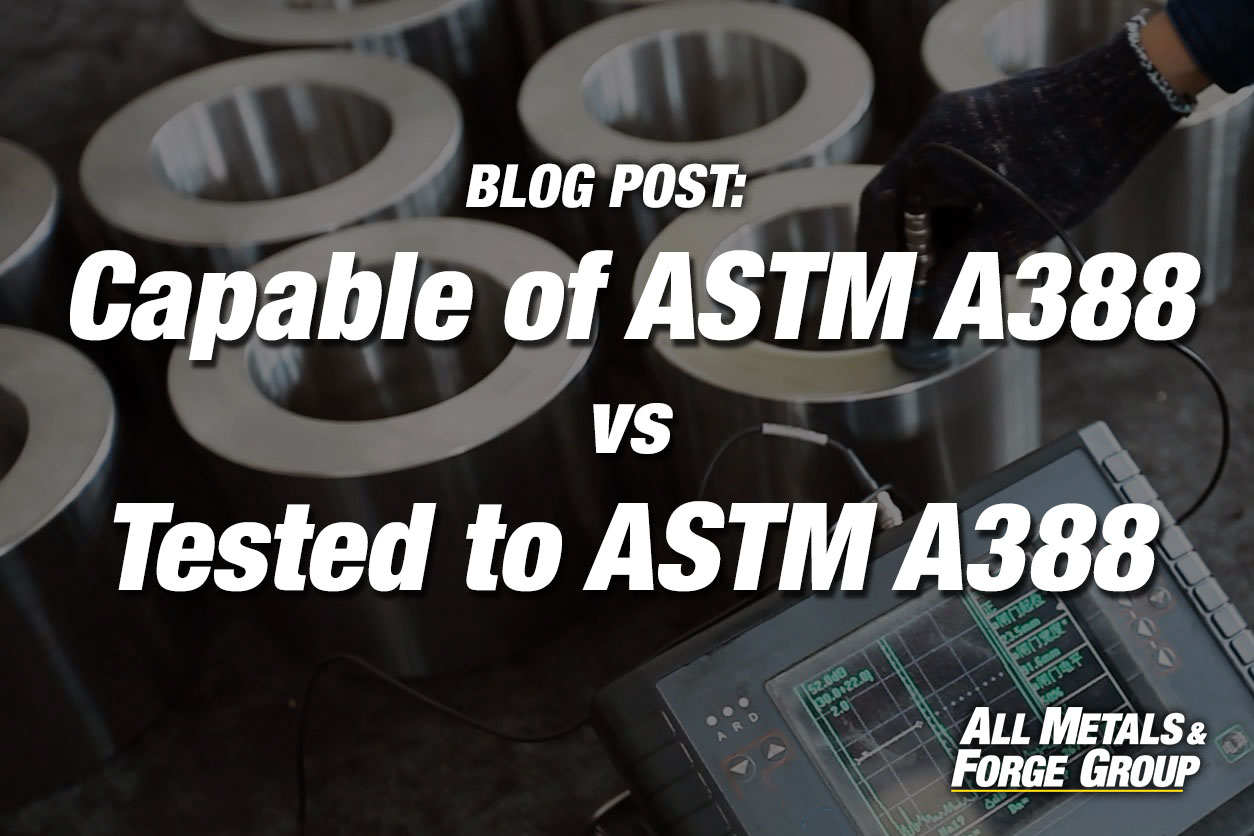
AMFG also ultrasonically examines every forging in accordance with ASTM A388/A388M using qualified in-house nondestructive testing personnel. Why is this so important? Because one of the risks associated with machining a large forged component is discovering a material problem after you’ve done a ton of work.
Imagine spending hours and hours on a large part only to find an internal indication that makes the component unacceptable to the applicable spec.
Now the loss is not just the value of the forging.
It includes machine time, labor, tooling, inspection, scheduling disruption, and maybe the cost of missing the customer’s deadline. By performing ultrasonic testing before shipment, AMFG helps provide machine shops with greater confidence in the forged part they are about to put on their machine.
Standardize Whatever Can Be Standardized
Machine shops do not need to automate every aspect of estimating to improve quote turnaround.
A good starting point is documenting the knowledge already inside the business.
For frequently quoted components, shops can establish historical benchmarks for:
- Setup hours
- Material removal rates
- Programming time
- Inspection time
- Tooling consumption
- Typical workholding strategies
- Outside processing
- Handling requirements
When you know that an AMFG forging is going to arrive rough-machined, near-net size, ultrasonically tested, a lot of questions can already be answered before the RFQ ever reaches the estimator.
The expert is then free to focus on the difficult variables rather than gathering basic information. That is how shops begin converting tribal knowledge into a repeatable quoting system.
Faster Quotes Can Improve More Than Your Win Rate
There is another benefit to reducing the quoting bottleneck. It improves the customer experience.
A fast, accurate response communicates competence. Even if the shop does not ultimately win the project, a buyer who receives a professional quote quickly is more likely to go to that company for future RFQs.
Slow responses send a different message, even when the reason has nothing to do with the shop’s capabilities. The customer does not know that your estimator was resolving a critical production issue. They only know that they asked for pricing Tuesday and didn’t get it until Friday. Speed has become a huge part of customer service.
Do Not Let Your Inbox Decide Which Jobs You Win
As you know, machine shops invest heavily in productivity on the floor. They buy faster machines. They install automation. They improve tooling. They implement scheduling software. They monitor cycle times.
Doesn’t the front end deserve the same attention? If a customer is ready to buy, the quoting process should move the opportunity forward, not become an obstacle. Working with suppliers that deliver more predictable inputs is one way to reduce the uncertainty your estimators have to manage. For forged components, that means starting with a part that arrives closer to the configuration your shop actually needs.
Quote Your Next Forged Part with Confidence
All Metals & Forge Group manufactures custom open-die forgings and seamless rolled rings for machine shops and OEM manufacturers across a broad range of industries and alloys.
Every AMFG forging includes rough machining to 250 RMS or better, machining to within 3 millimeters of finished dimensions, and ultrasonic examination in accordance with ASTM A388/A388M.
If faster, more predictable quoting can help your shop compete for more work, start by giving your estimator a better starting point.