Go With The Flow
In high-performance industrial applications, material integrity is not optional. It is engineered. One of the most critical yet often overlooked factors influencing the strength and durability of forged components is grain flow. Understanding how grain flow develops during the forging process, and how it can be controlled, is essential for engineers, buyers, and machine shops seeking reliable, high-quality parts.
What Is Grain Flow?
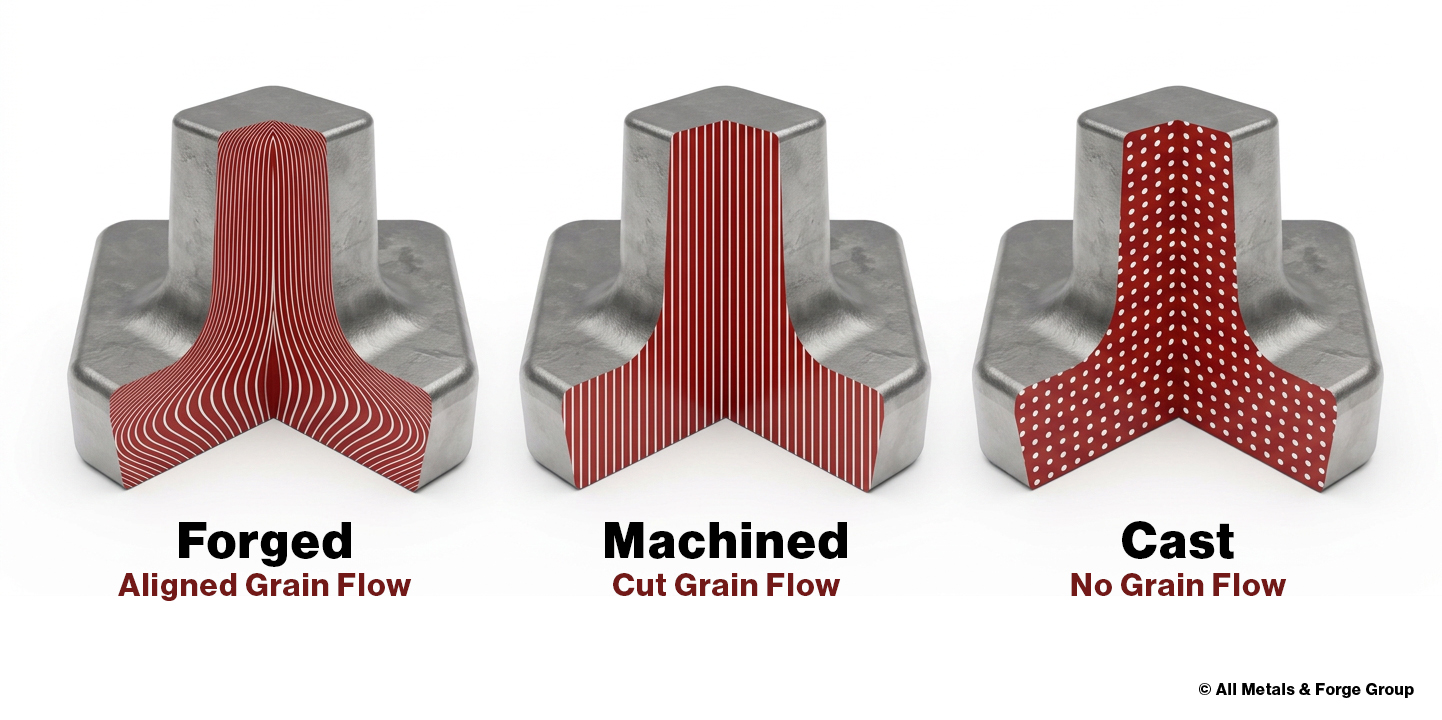
Grain flow refers to the orientation and alignment of a metal’s internal grain structure as it is plastically deformed during forging. In its raw state, metal typically has a relatively uniform or random grain structure. When subjected to compressive forces in an open-die forging process, those grains elongate and realign, following the geometry of the part.
Unlike machining from bar or plate, which cuts through the natural grain structure, forging reshapes the material while preserving continuity. This results in a directional grain pattern that mirrors the contours of the finished component.
In open die forging, an ingot or a billet is deformed between dies that are flat or relatively simple-shaped, using hammers or presses.
Why Grain Flow Matters in Forged Parts
Properly developed grain flow has a direct impact on the mechanical properties and long-term performance of forged components:
1. Increased Strength and Fatigue Resistance
Aligned grain flow improves resistance to cyclic loading and fatigue failure. This is especially critical in rotating components such as shafts and gear blanks.
2. Enhanced Impact Toughness
Continuous grain structure allows the material to absorb energy more effectively, reducing the likelihood of brittle fracture under sudden loads.
3. Improved Structural Integrity
Forging eliminates internal voids and discontinuities, producing a dense, cohesive material structure that performs reliably in demanding environments.
4. Directional Performance Optimization
By aligning grain flow with the primary stress paths of a component, forged parts can be engineered for superior performance compared to cast or machined equivalents.
Grain Flow vs. Machined Components
When parts are machined from rolled bar or plate, the cutting process interrupts the natural grain structure. This can create stress concentration points and reduce fatigue life.
In contrast, open-die forging preserves and enhances grain continuity. For example:
- A forged shaft maintains grain flow along its longitudinal axis, maximizing torsional strength
- A seamless rolled ring develops circumferential grain flow, ideal for pressure containment and rotational stability
- A forged flange or disc can be processed to align grain flow with load-bearing surfaces
This distinction is a key reason why critical industries rely on forged components for high-stress applications.

How Grain Flow Is Controlled in Open-Die Forging
Achieving optimal grain flow is not incidental. It is the result of controlled process variables and metallurgical expertise.
At All Metals & Forge Group, grain flow is developed through:
Controlled Deformation
Strategic application of compressive forces shapes the material while guiding grain orientation to the part’s geometry.
Process Sequencing
Multiple forging steps, including upsetting, drawing, and rolling, are used to refine grain structure and eliminate internal defects.
Temperature Management
Maintaining proper forging temperatures ensures ductility while preventing grain coarsening or undesirable microstructural changes.
Near-Net Shaping
Producing parts close to final geometry allows grain flow to follow the end-use profile, reducing the need for excessive machining that could disrupt the structure.
Grain Flow in Key Forged Products
Grain flow considerations vary depending on the part’s geometry and application. AMFG manufactures a wide range of components where grain orientation is critical:
Seamless Rolled Rings
With diameters up to 200 inches, these components exhibit circumferential grain flow, making them ideal for bearings, gears, and pressure vessels.
Gear Blanks
Forged to align grain flow with tooth geometry, improving fatigue resistance and extending service life in high-load gear systems.
Flanges and Discs
Engineered for pressure and load distribution, with grain flow optimized for structural integrity in piping and energy applications.
Shafts and Cylinders
Produced with longitudinal grain flow to maximize strength under torsional and axial loads.
Quality Assurance and Verification
While grain flow itself is not directly visible in finished components, its effects are verified through rigorous quality control processes.
All Metals & Forge Group supports grain structure integrity through:
- Ultrasonic testing on every order to detect internal discontinuities
- Controlled forging processes aligned with ASTM and AMS standards
- ISO 9001:2015 and AS9100D registered quality systems
- Material traceability and certification to customer specifications
These measures ensure that the benefits of proper grain flow are realized in every delivered part.
Why It Matters for Machine Shops and OEMs
For machine shops and OEMs, starting with a forged part that has optimized grain flow translates directly into operational and economic advantages:
- Reduced machining time through near-net shapes
- Improved tool life due to consistent material properties
- Lower risk of part failure in service
- Greater confidence in meeting performance specifications
Choosing the right forging partner ensures these benefits are built into the material from the start.
Partner with a Forging Expert
Grain flow is not just a metallurgical concept. It is a competitive advantage when executed correctly. At All Metals & Forge Group, every forging is produced with a focus on structural integrity, performance, and reliability.
With capabilities including seamless rolled rings, complex forged shapes, and near-net machining within 3 mm of finished size, AMFG delivers components engineered to perform in the most demanding environments.
Contact All Metals & Forge Group today at sales@steelforge.com to discuss your next project or submit an RFQ here.