
“Capable of ASTM A388” vs.
“Ultrasonically Tested to ASTM A388”

Why the Distinction Matters in Forging Procurement, Quality Assurance, and Risk Management
In the world of forged components, few phrases cause more confusion – or more quality escapes – than the difference between “capable of ASTM A388” and “ultrasonically tested to ASTM A388.” On paper, they sound similar. In practice, they are worlds apart.
The distinction determines whether you receive a forging that can be ultrasonically tested… or one that has actually undergone ultrasonic examination (UT) in accordance with the ASTM A388 standard.
Understanding this difference is essential for engineers, buyers, inspectors, and anyone responsible for ensuring the integrity of critical components.
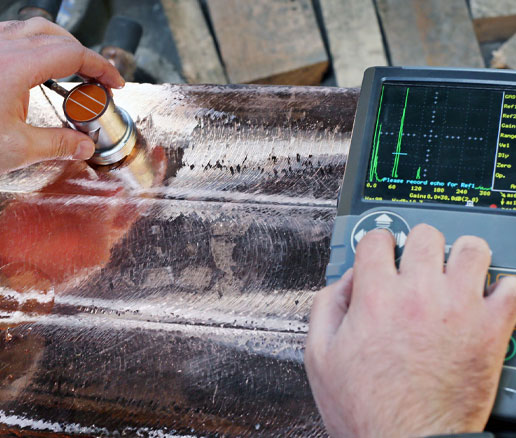
1. What ASTM A388 Actually Covers
ASTM A388 is the industry standard for ultrasonic examination of steel forgings. It defines:
- Required equipment and calibration blocks
- Scanning procedures
- Acceptance criteria
- Reporting requirements
- Qualification of operators
When a forging is tested to ASTM A388, it means the part has been scanned using these procedures and evaluated against the acceptance criteria.
2. What “Capable of ASTM A388” Really Means
This phrase is often misunderstood – sometimes innocently, sometimes strategically.
“Capable of ASTM A388” means only this:
The forging’s geometry and surface condition allow it to be ultrasonically tested in accordance with ASTM A388.
It does not mean:
- The forging was actually tested
- Any UT equipment was used
- Any acceptance criteria were applied
- Any UT report exists
It simply means the part could be tested – if someone were to do it.
| Requirement | Meaning | What You Get |
| Capable of ASTM A388 | Geometry and surface allow UT | No UT performed, no report, no acceptance criteria applied |
| Ultrasonically tested to ASTM A388 | UT performed per the standard | Full UT scan, acceptance evaluation, documented results |
Why this phrase appears on quotes and certs:
The forging shop wants to indicate the part is UT-friendly
The customer did not explicitly require UT
The supplier wants to avoid the cost and liability of performing UT
It keeps the price lower unless UT is specifically added
This is a capability statement, not a quality statement.
3. What “Ultrasonically Tested to ASTM A388” Means
This is the real thing – the actual performance of the examination.
A forging that is ultrasonically tested to ASTM A388 has:
- Been scanned by a qualified UT technician
- Followed the calibration and scanning procedures in the standard
- Been evaluated against the acceptance criteria
- Produced a UT report documenting results
- Either passed or failed based on the standard
This is a verified quality condition, not a capability.
4. Why the Difference Matters
A. Risk Exposure
If a forging is only capable of UT, internal discontinuities may exist that no one has looked for.
For critical applications – pressure vessels, turbine components, crane hooks, oilfield equipment, aerospace hardware – this is unacceptable.
B. Cost vs. Liability
Forgings that are actually tested cost more because:
UT requires skilled labor
UT requires calibrated equipment
UT requires documentation
UT introduces the possibility of rejection
But skipping UT to save money can introduce far greater downstream costs.
C. Contractual Ambiguity
Many quality escapes occur because a PO says:
“Forging must be capable of meeting ASTM A388.”
The supplier delivers a forging that could be tested. The customer assumes it was tested. No one notices until a failure occurs.
5. How to Specify What You Actually Want
To avoid ambiguity, procurement documents should use explicit language.
If you want actual UT performed:
“Forgings shall be ultrasonically tested in accordance with ASTM A388, Level ___, and a UT report shall be provided.”
If you only want UT capability (rare):
“Forgings shall be capable of ultrasonic examination per ASTM A388. No UT is required unless otherwise specified.”
The difference between these two sentences is the difference between inspection performed and inspection possible.