
Tool Steel Forged Parts
Tool Steel Forged Parts
All Metals & Forge Group manufactures high-performance tool steel forged parts for demanding tooling and metal-forming applications. Tool steels such as A2, D2, S7, O1, O6, A10, H13, M2, and S5 serve critical roles in cutting, forming, blanking, and machining operations across many industries.
Manufacturers rely on tool steel components for cutting tools, blanking dies, deep drawing dies, molds, tap and die sets, shear blades, drills, cold heading tools, hot forging tools, and die casting dies. Because these tools shape or machine other metals, they must maintain hardness, wear resistance, and dimensional stability under extreme stress.


Properties and Classifications of Tool Steel
Tool steels typically contain high carbon levels, often near 1%, along with alloying elements such as chromium, molybdenum, vanadium, and tungsten. These elements form hard carbides that improve abrasion resistance and edge retention. As a result, tool steel forged parts maintain sharp cutting surfaces even at elevated temperatures.
Tool steels fall into several classifications:
-
Water hardening steels
-
Oil hardening steels
-
Air hardening steels
-
Cold work tool steels
-
Hot work tool steels
-
High-speed tool steels
High-speed grades, in particular, offer excellent red hardness and deep hardening capability. Therefore, they perform well under high friction and cutting temperatures common in CNC machining and heavy forming operations.
Forging and Heat Treatment Requirements
The production of tool steel forged parts demands strict control from melting and degassing through forging and final heat treatment. Because tool steels respond sensitively to temperature and reduction ratios, we carefully monitor forging parameters to preserve internal integrity.
Heat treatment plays a decisive role in performance. Incorrect hardening temperature, improper quenching medium, or inadequate tempering can lead to cracking, distortion, or reduced wear resistance. Consequently, we follow controlled heating, soaking, quenching, and tempering procedures tailored to each grade.
Non-destructive testing throughout the manufacturing process verifies internal soundness. If testing reveals internal defects such as voids, segregation, or inclusions, we reject the material rather than compromise quality.
Design Considerations for Tooling Applications
Tool designers must avoid sharp corners and abrupt section changes that concentrate stress. Excessive stress in service can lead to premature failure, especially after heat treatment. Therefore, proper geometry and processing remain essential for long tool life.
Because tool steel forged parts operate under severe mechanical and thermal conditions, material selection, heat treatment, and dimensional accuracy must align precisely with end-use requirements.
Quality Control and Machining Advantages
All Metals & Forge Group operates under an ISO 9001:2015 and AS9100D registered quality system. We begin each project by reviewing the customer’s end use, required mechanical properties, forging geometry, surface condition, and delivery schedule.
Every tool steel forged part undergoes ultrasonic testing to confirm internal integrity. In addition, we rough machine forgings to within 3 mm of finished dimensions. This practice reduces downstream CNC machining time and cost. Our standard rough-machined surface finish is 250 RMS, which allows accurate inspection before final processing.
When required, we perform finish machining to tolerances as tight as ±0.001 inch with 64 or 32 RMS surface finishes. Many suppliers ship tooling components in the black or at 500 RMS; however, our machining standards significantly reduce final machining time.
From inquiry through shipment, we manage quality at every stage. Whether producing a single die component or a full tooling program, we deliver tool steel forged parts built for durability and performance.
Common Tool Steels
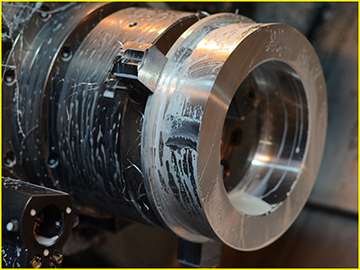
All Metals & Forge Group takes great pride in maintaining one of the most stringent ISO9001, AS9100 quality systems in the open die forging and seamless rolled ring industry. It begins with learning the customer’s end use, required forging surface condition, mechanical properties of the specified material and alloy, forged shape, heat treatment, delivery need, and competitive price, coupled with forging soundness proven by ultrasonic testing, and care in packing goods to arrive in pristine condition at the customer’s desired location. Every step is monitored by the quality system at AMFG and continuously improved.
AMFG performs rough machining to within 3mm of finish dimensions to reduce the CNC cost at the customer’s machine shop for all the forged shapes the company produces. The rough machine surface condition is 250 RMS so that proper quality testing can be performed on each part – the AMFG standard.
The company can perform finish machining to within .001 of an inch for final tolerance and 64 or 32 RMS surface finish. This level of quality and precision is unique in an industry where other company’s parts are often delivered black, as forged, or with a rough machined surface of 500 RMS without the internal or external steps and dimensions to reduce machining costs.
From inquiry to invoice, All Metals & Forge Group quality is managed and not assumed. Whether the need is for one part, an entire project, or a production run, AMFG delivers.
U.S. 1 (973) 276-5000 • 1 (800) 600-9290 • Canada 1 (416) 363-2244
Fax: 1 (973) 276-5050 • Sales@Steelforge.com
Fast Quotes And Delivery
Save time and money on your next project.
In the U.S. 1 (973) 276-5000 / 1 (800) 600-9290.
In Canada 1 (416) 363-2244.
Email us at sales@steelforge.com.